
For decades, the standard technology engagement has followed a familiar pattern: define requirements, build software, launch it, hand it over. Success is usually judged by whether the agreed functionality was delivered on time and within budget.
That model made sense when software was mainly a tool for digitising known processes. A new website, portal, application or workflow system could be scoped as a discrete project. Build the thing. Release it. Move on.
AI changes the nature of the work.
The value no longer sits primarily in the software itself. It sits in an operating system of people, decisions, data, workflows and ongoing learning. The technology matters, but it is only useful when it changes what an organisation can reliably achieve.
This is why many are moving from software projects to AI-enabled value systems.
Software solves a defined problem. Value systems keep improving the way a business creates value.
A traditional software project begins with a specification. It assumes the organisation knows what it needs, how people will use it and what a good result looks like. The project team translates that knowledge into features.
AI introduces a different proposition. It can interpret information, generate content, identify patterns, recommend actions and automate parts of knowledge work. But these capabilities are probabilistic rather than fixed. They need oversight. They need feedback. They need people who know when to trust the output, when to question it and how to act on it.
That makes the work less like constructing a building and more like designing a living operating system.
The important question is no longer, “What software should we build?”
It is, “What business outcome are we trying to create, and what must change for that outcome to persist?”
That shift is practical, not philosophical.
Consider a company that introduces an AI assistant to help its sales team prepare proposals. The software may work exactly as intended. It may produce usable drafts in seconds. Yet the programme can still fail to create value if salespeople do not trust it, if the proposals use the wrong commercial judgement, if no one owns quality assurance, or if the team simply uses the saved time to produce more low-value activity.
The technology is present. The value system is not.
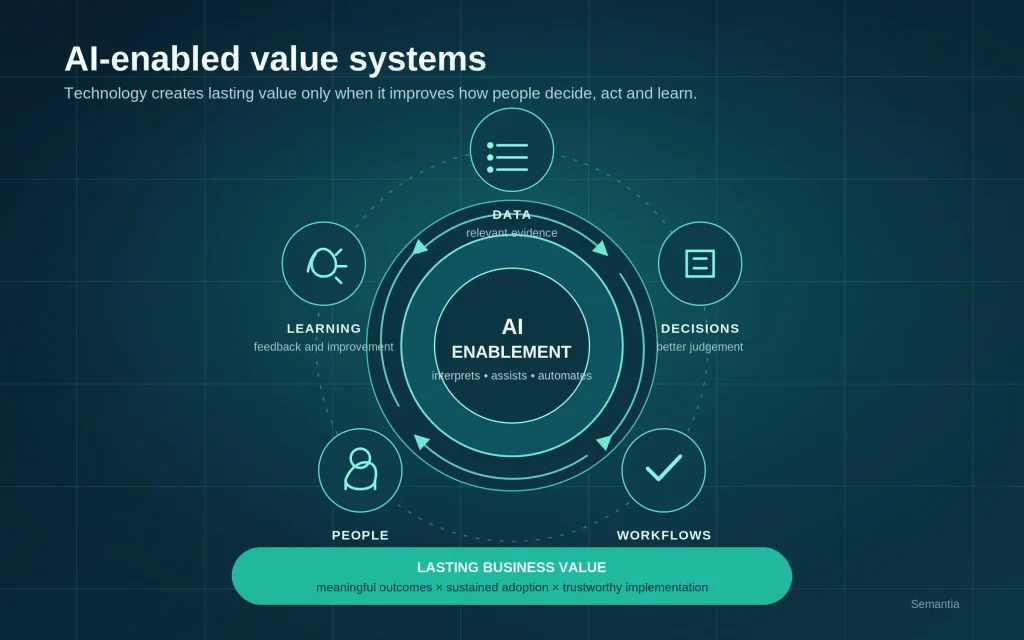
What makes an AI-enabled value system?
An AI-enabled value system brings together five elements.
1. A meaningful business outcome
This needs to be concrete: improve proposal win rates, reduce customer onboarding time, lower the cost of service, improve conversion, or make better decisions faster. “Implement AI” is not an outcome.
2. A behavioural design
New tools do not change an organisation merely because they are available. People need clear reasons to use them, low-friction ways to adopt them, appropriate incentives and confidence that using them will not create hidden risk or extra work.
3. Trusted implementation
AI must sit within real governance: clear accountability, suitable data practices, quality controls, escalation paths and human judgement where it matters. Trust is not a compliance layer added at the end. It is a condition of adoption.
4. Integration into the work itself
The system must fit the decisions, handovers and routines that already determine performance. A capable AI tool that requires people to leave their usual workflow or duplicate work will struggle to survive beyond early enthusiasm.
5. Continuous learning
Every use of an AI system creates evidence. Where does it help? Where does it introduce errors? What do customers respond to? Which teams adopt it and why? A value system uses that evidence to improve the process, the tool and the surrounding behaviour over time.
This is a more demanding model than buying or building software, but it is also more honest.
The real challenge is translation
Most organisations do not have a technology problem. They have a translation problem: turning technological possibility into repeatable commercial and human value.
That is where behavioural design becomes essential.
AI can generate an answer, but it cannot by itself make a team change a habit. It cannot resolve competing incentives between departments. It cannot decide whether faster work is also better work. And it cannot create trust if people believe the system is opaque, risky or imposed on them.
Behavioural design addresses these practical realities. It looks at the moments where people make decisions, the frictions that prevent good action, and the conditions that make a new behaviour easier to sustain.
In an AI context, this might mean designing a review step into a workflow, giving teams examples of good use, clarifying when human approval is required, or measuring outcomes that people can influence.
The aim is not to persuade people to “embrace AI”. It is to make a better way of working practical, credible and worthwhile.
How to invest differently
Rather than beginning with a large transformation programme or a broad platform rollout, start with a valuable and bounded problem.
Diagnose the friction in the current system. Identify where AI could improve a decision, reduce waste or make an important behaviour easier. Run a focused experiment. Measure both operational outcomes and human adoption. Then embed what works into the wider workflow.
This sequence matters:
- Diagnose the value friction.
- Experiment with a specific intervention.
- Embed the successful change into everyday practice.
- Optimise through ongoing evidence.
It is slower than buying a tool and calling it transformation. It is much faster than spending a year on a system that nobody uses.
The opportunity ahead
The organisations that benefit most from AI will not necessarily be those with the most advanced models or the largest technology budgets. They will be the ones that can connect technical capability to a meaningful business outcome, design for real human behaviour and keep learning after launch.
Software projects end when the product is delivered.
AI-enabled value systems begin there.