
Most organisations approach AI performance the way people approached early websites: add more content, more instructions and more rules, then hope the system becomes more useful.
It usually has the opposite effect.
A general-purpose AI system can read documents, use tools, search knowledge bases and work through a task. When it fails, the instinct is often to add another agent, expand the system prompt, or write a longer project instruction file. Before long, the organisation has a pile of prompts, agent configurations, shared documents and “rules” that nobody fully owns.
The AI is not short of information. It is short of structure.
The problem with global context
Every AI system operates with some global context: basic behaviour rules, organisational policies, project information, and constraints that apply to every request.
That global layer matters. It should contain the things that are genuinely stable and universally relevant. Security boundaries. Architecture principles. Required approval steps. The location of authoritative systems.
The trouble starts when it becomes a dumping ground.
A long instruction file can contain historic decisions, outdated technical details, task-specific exceptions, duplicated policies and preferences that only apply to one team. If that material arrives with every request, it shapes every answer. It can make the system slower, more confused and less consistent.
People have the same problem. Give a team a 200-page policy manual before every decision and they do not become more capable. They become less certain about what matters.
AI needs context, but context has a cost.
The useful distinction: global, local and live context
A reliable AI-enabled workflow separates information according to how it should be used.
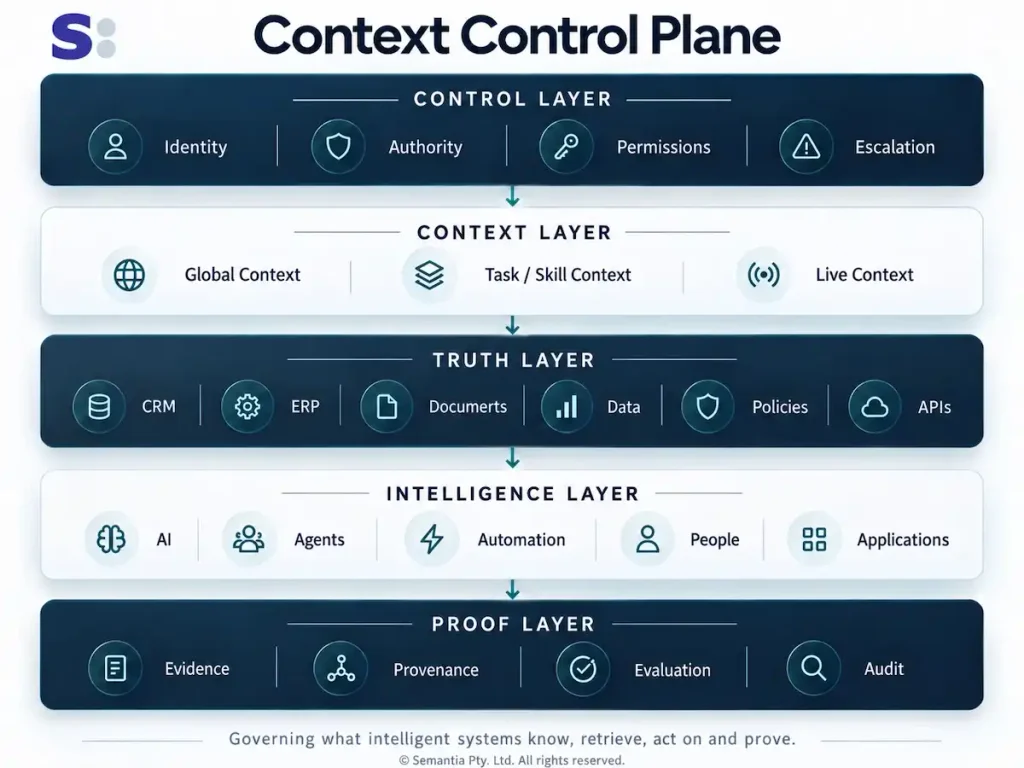
Global context includes stable rules that apply to most work. Think security, tone, regulatory boundaries, core architecture decisions and escalation requirements.
Task context includes the process, tools, examples and validation steps needed for a specific job. A financial research workflow needs different instructions from a customer-support workflow or a software-release workflow.
Live context comes from the systems that hold current truth: CRM records, operational data, product information, policies, contracts, inventory, service history or project status.

This distinction is easy to describe but hard to implement. It requires an organisation to decide what its systems should know by default, what they should retrieve only when needed, what they can act on, and what must be checked by a person.
That is not prompt engineering. It is operating design.
Why skills matter
A skill is a reusable package of operating knowledge. It can contain a repeatable method, instructions, scripts, templates, reference material and a way to verify that the work is complete.
The point is not to give every department its own novelty agent. The point is to stop asking a general AI system to rediscover the same process every time.
Consider a recurring task such as preparing a board report. A capable system may be able to draft the report from scratch, but it will still need to work out the expected structure, the data sources, the approval rules, the visual template, the calculations, the caveats and the final checks. If that knowledge already exists, rebuilding it on every run is wasteful and unreliable.
A well-designed skill gives the system a proven path. It also makes the process visible to the people responsible for it.
This works best when the skill is narrow enough to be useful and broad enough to survive small changes. “Write anything about our company” is not a skill. “Prepare a monthly operating review using approved data sources, the current board template and defined financial checks” is much closer.
The risk organisations often miss
The risk is not simply that an AI system produces a weak answer. The larger risk is that it produces a plausible answer from the wrong context.
An AI may apply an old policy, rely on an incomplete customer record, assume it has authority it does not have, or present a recommendation without showing where the facts came from. These failures are often subtle. The language can sound confident. The work can look complete.
That is why good AI design needs more than a useful prompt. It needs:
- clear sources of truth;
- permissions that match the action being taken;
- evidence and provenance for important outputs;
- human review where the consequence warrants it;
- evaluation of failures, edge cases and drift;
- ownership for the knowledge and rules the system uses.
A system should not receive every document in the organisation just because it might be useful. It should receive the relevant information, at the relevant point in the workflow, with the right constraints.
A better question for leadership teams
Many leaders start with: “Where can we use AI?”
A more useful question is:
Where are we repeatedly rebuilding knowledge, decisions or coordination work because our operating context is not available when people need it?
That question leads to better opportunities.
It might reveal a sales team that recreates account history before every proposal. A service team that searches several systems to understand a customer issue. A finance team that repeats the same reconciliation logic each month. A project team that depends on one experienced person to remember the exceptions that keep delivery on track.
AI may be part of the answer. Sometimes the right intervention is simpler: remove an unnecessary step, standardise a handoff, clean up a data source, connect two systems, or leave a decision with a person.

The sequence matters:
Eliminate. Simplify. Standardise. Integrate. Automate. Augment. Agentise.
Not every process deserves an agent.
The Semantia approach: Context Control Plane
At Semantia, we describe this as a Context Control Plane: an operating architecture that governs what intelligent systems know, retrieve, act on and prove.
The work begins with the workflow, not the model.
Identify where people are losing time to repeated interpretation, fragmented information, unclear handoffs and knowledge held in individual heads.
Classify the context involved.
Connect the systems that contain current truth.
Define the permissions, exceptions and checks that make the work safe.
Finally, we prove the design in a bounded workflow before expanding it.
The result is not an AI system that knows everything.
It is an intelligent system that knows enough to perform useful work, can show its basis, operates within clear boundaries, and improves through evidence rather than guesswork.
That is the difference between an impressive demonstration and an organisational capability.
Start with one workflow
The best starting point is usually one recurring, high-friction workflow where the cost of rebuilding context is visible.
Choose work that has a clear owner, a defined outcome, enough data to inspect, and a reasonable way to measure improvement. Map the information needed at each decision point. Identify what is stable, what is current, what is sensitive and what needs human confirmation.
Then test a narrow intervention.
If the system reduces turnaround time, improves consistency, makes the evidence clearer and removes repetitive effort without creating a new governance burden, it has earned the right to expand.
If it does not, the organisation has still learned something valuable about its process, data and decision design.
Semantia helps organisations build that capability across workflows, systems and teams. The objective is practical: make the way your best people work available when the organisation needs it, not only when those people happen to be in the room.