
Most organisations begin their AI conversations with the wrong question.
They ask:
“Where can we use AI?”
It sounds sensible. It is also limiting.
The question starts with a technology and looks for a problem to attach it to. That can produce impressive demonstrations, isolated pilots and a growing collection of tools. It does not necessarily produce a better organisation.
A more useful question is:
Where is valuable human capability being consumed by avoidable friction — and what combination of process, systems, information, automation, AI and judgement would make that work better?
That is the beginning of organisational capacity design.
AI is becoming easier. Organisational change is not.
The ability to build an AI-enabled workflow is becoming more accessible. Models are better. Integration tools are simpler. More people understand what an agent, assistant or automation can do.
That matters. But it changes where the real challenge sits.
The difficult question is increasingly not whether an organisation can deploy a tool. It is whether it has identified the right work to change, the information that work depends on, the risks it must manage, the people who will own it, and the measure that will prove it made a difference.
In other words: building may become cheaper, but deciding what to build — and making it durable — remains difficult.
An organisation does not gain much from automating a flawed process faster. Nor does it benefit from an AI assistant that cannot access reliable knowledge, a workflow with no accountable owner, or a pilot that cannot be integrated into everyday operations.
The hidden cost of operational friction
Every business has work that consumes more human attention than it should.
It appears in different forms:
- staff re-entering information between systems;
- teams searching for answers that should be readily available;
- decisions waiting in queues because the relevant context is fragmented;
- experienced employees acting as the unofficial bridge between disconnected processes;
- customer enquiries created by unclear communications or poor self-service;
- work being checked, corrected or repeated because the underlying process is unreliable;
- reporting assembled manually because systems were never designed to share meaningfully comparable data.
These are not merely efficiency problems. They are capacity problems.
When capable people spend their time chasing information, reconciling systems, interpreting inconsistent rules or repairing avoidable errors, the organisation loses more than hours. It loses judgement, responsiveness, learning and the ability to focus on work that genuinely requires human expertise.
The opportunity is not simply to remove people from processes. It is to make better use of people where their judgement matters most.
The right intervention is not always AI
This is the discipline many technology conversations miss.
A workflow may be improved by AI. It may also be improved by removing a needless approval, simplifying a form, standardising a decision, improving a knowledge source, connecting two systems, clarifying responsibility or retaining a human review point.
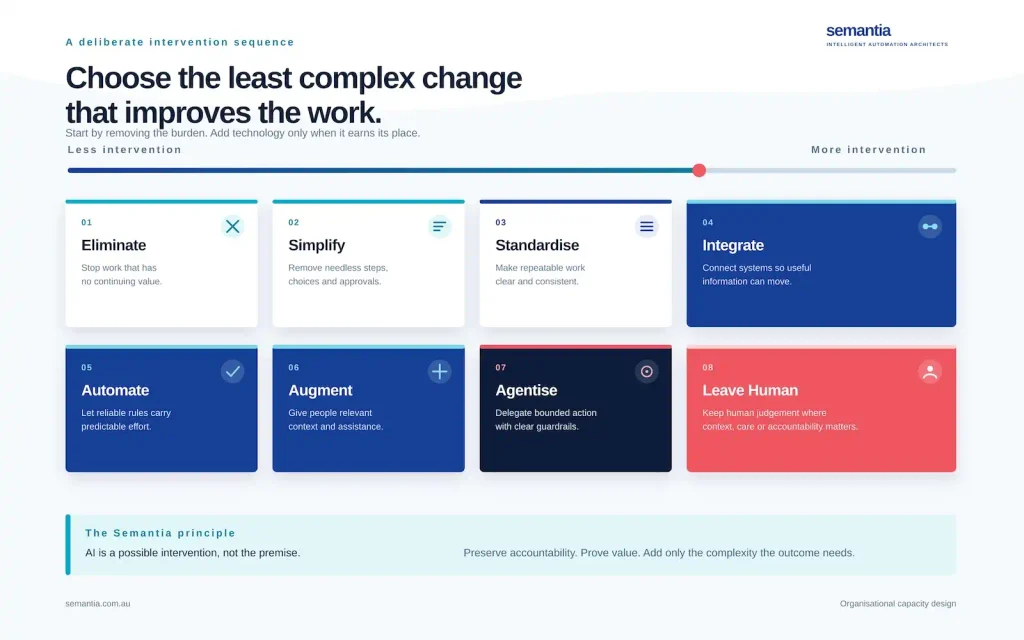
The appropriate sequence is usually:
Eliminate → Simplify → Standardise → Integrate → Automate → Augment → Agentise → Leave Human
Not every process needs to travel all the way along that sequence.
Sometimes the best answer is to remove the work altogether. Sometimes it is to redesign the process before introducing technology. Sometimes automation is appropriate, but an autonomous agent is not. And sometimes a human decision-maker should remain firmly in the loop.
That is not a lack of ambition. It is good operational design.
From AI experiments to organisational capacity
A more mature approach starts with the organisation’s work rather than its technology.
It asks:
- Where do processes stall, repeat or generate rework?
- Which decisions are delayed because information is hard to find or trust?
- Where are people compensating for disconnected systems?
- Which outcomes depend too heavily on particular individuals?
- What work creates avoidable demand for customers or employees?
- Where could a better combination of process, knowledge, systems and judgement release meaningful capacity?
- How will we know that the change worked?
This approach turns AI from an innovation activity into part of a broader operating model.
The goal is not a collection of impressive tools. The goal is an organisation that can turn information, systems and human capability into reliable outcomes with less friction.
A practical path: expose, decide, prove, embed, compound
At Semantia, we see this as a progression of confidence rather than a technology rollout.
1. Expose the friction
Make the hidden work visible: delays, handoffs, duplicated effort, decision bottlenecks, exceptions, rework and key-person dependencies.
The output is not a generic list of AI ideas. It is a defensible picture of where operational capacity is being lost.
2. Decide what should change
Assess the available interventions against value, risk, readiness, data quality, accountability and adoption.
The question is not “Where can we deploy a chatbot?” It is “What is the most responsible and valuable way to improve this work?”
3. Prove the outcome
Deliver a contained intervention with clear boundaries, controls and measures.
That might be a redesigned workflow, a trusted knowledge layer, a system integration, an automation, an AI-enabled assistant or a carefully governed agent. The important thing is that it produces evidence in the real operating environment.
4. Embed the capability
A useful system should not depend indefinitely on the people who built it.
Ownership, governance, knowledge stewardship, monitoring, exception handling and staff capability are what turn a promising proof into an operational asset.
5. Compound the value
The strongest improvements make future improvements easier.
When an organisation develops reusable integrations, trusted knowledge assets, clearer operating measures and proven governance patterns, it reduces the cost and risk of the next change. Capability compounds.
The strategic opportunity
The emerging competition will not be won by organisations that merely adopt the most AI tools.
It will be won by those that can redesign work intelligently: deciding where human judgement is essential, where systems should carry more of the load, where information should flow more freely, and where automation can improve performance without weakening trust or control.
That is a more demanding ambition than “doing AI”.
It is also more valuable.
The question for leaders is no longer simply:
“How can we use AI?”
It is:
“Where is our organisation unnecessarily consuming human capability and how can we redesign the work so that people, systems and intelligence each do what they do best?”
That is how fragmented activity becomes durable organisational capacity.